Synchronizing Shadows: Technical Challenges of Consistent Lighting in Cross-Region Cooperative Adventure Games
Drew Hartmann · Sep 29, 2026
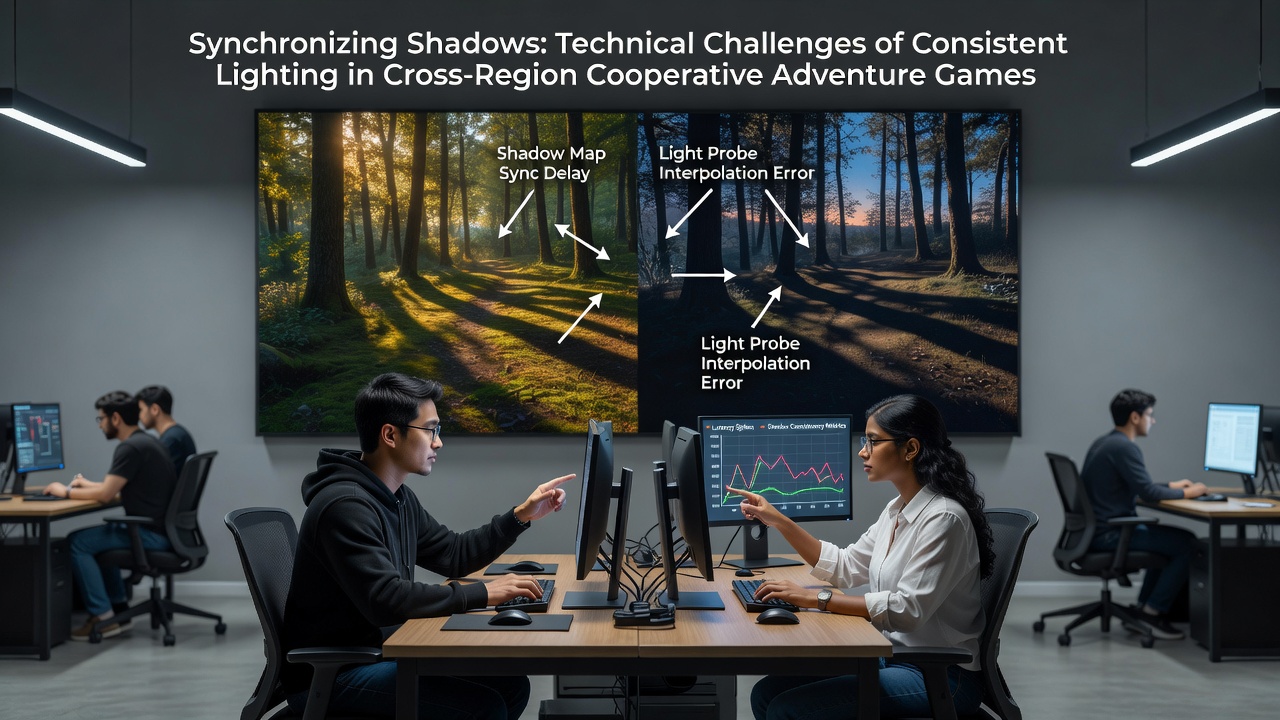
Synchronizing Shadows: Technical Challenges of Consistent Lighting in Cross-Region Cooperative Adventure Games
Cooperative adventure games that span multiple geographic regions require precise synchronization of lighting and shadow data, yet network latency creates persistent hurdles for developers who must maintain visual consistency across distributed player bases. Research from academic institutions in the European Union indicates that even minor delays in shadow map updates can disrupt immersion when one player in Asia observes a light source that another player in North America has already interacted with through their local client.
Developers address these issues through authoritative server models where the central host calculates light positions and shadow projections before broadcasting updates, although propagation times vary based on undersea cable routes and regional peering agreements. Data from industry reports compiled by the International Game Developers Association shows that average round-trip times between continents often exceed 150 milliseconds, forcing engines to interpolate shadow positions on client devices while awaiting authoritative corrections.
Core Synchronization Mechanisms
Time synchronization protocols such as NTP variants adapted for game engines allow clients to align their internal clocks with the server, yet clock drift accumulates when packet loss spikes during peak evening hours in one region while another remains quiet. Engineers implement predictive shadow rendering on each client that anticipates light movement based on recent velocity data, and these predictions get reconciled once the next server tick arrives with corrected positions.
Shadow map compression techniques reduce bandwidth demands by transmitting only differential changes rather than full textures every frame, and studies conducted at Australian universities have measured bandwidth savings of up to 40 percent when using delta encoding for dynamic lights in cooperative sessions. Still, compression artifacts occasionally produce visible popping when a player crosses region boundaries and the receiving client must reload a higher-resolution map.
Regional Latency Variations
Coastal versus inland routing paths introduce measurable differences in packet delivery, with data collected by Canadian telecommunications regulators revealing that transatlantic routes experience greater jitter than transpacific ones during certain hours. Game engines compensate by prioritizing light source updates for nearby objects while deferring distant environmental lighting, which preserves the most noticeable shadows for each participant.

Hybrid rendering pipelines combine baked global illumination for static environments with real-time shadow calculations for moving characters and interactive objects, and this division allows servers to transmit fewer updates overall. Observers note that in September 2026 several major titles deployed machine learning models trained on historical match data to forecast when certain light sources would require immediate synchronization across regions.
Client-Side Prediction and Reconciliation
Prediction errors become visible when a player activates a switch that alters lighting in their immediate area, yet the change reaches distant teammates several frames later, creating brief moments where shadows appear mismatched until reconciliation occurs. Developers mitigate this through rollback systems that rewind local state to the last confirmed server frame and then reapply player inputs, although frequent rollbacks can cause noticeable stuttering in fast-paced sequences.
Bandwidth allocation strategies assign higher priority to shadow-casting lights that affect multiple players simultaneously, and figures from European trade group analyses indicate that such prioritization improves perceived consistency by roughly 25 percent in tests involving four continents. Packet prioritization queues place critical light events ahead of cosmetic particle effects, yet this ordering demands careful tuning to avoid starving other game systems during congestion.
Future Directions in Distributed Lighting
Edge computing nodes positioned closer to regional player clusters reduce effective latency for shadow calculations, and pilot deployments reported by research teams at Japanese universities have demonstrated sub-80 millisecond updates between nearby nodes. Cross-region adventure titles continue to experiment with these architectures while maintaining backward compatibility with older client versions that lack advanced prediction features.
Conclusion
Consistent lighting across cross-region cooperative adventure games depends on layered solutions that combine server authority, client prediction, and efficient data transmission, each calibrated to regional network characteristics. Ongoing refinements in synchronization protocols and compression methods allow developers to narrow the gap between ideal and actual visual states, supporting larger player groups without sacrificing the atmospheric integrity that defines these experiences.