Exploring Buffer Management Strategies That Stabilize Data Flow in Cloud-Hosted Cooperative Adventure Games Across Multiple Time Zones
Frankie Schmitz · Oct 13, 2026
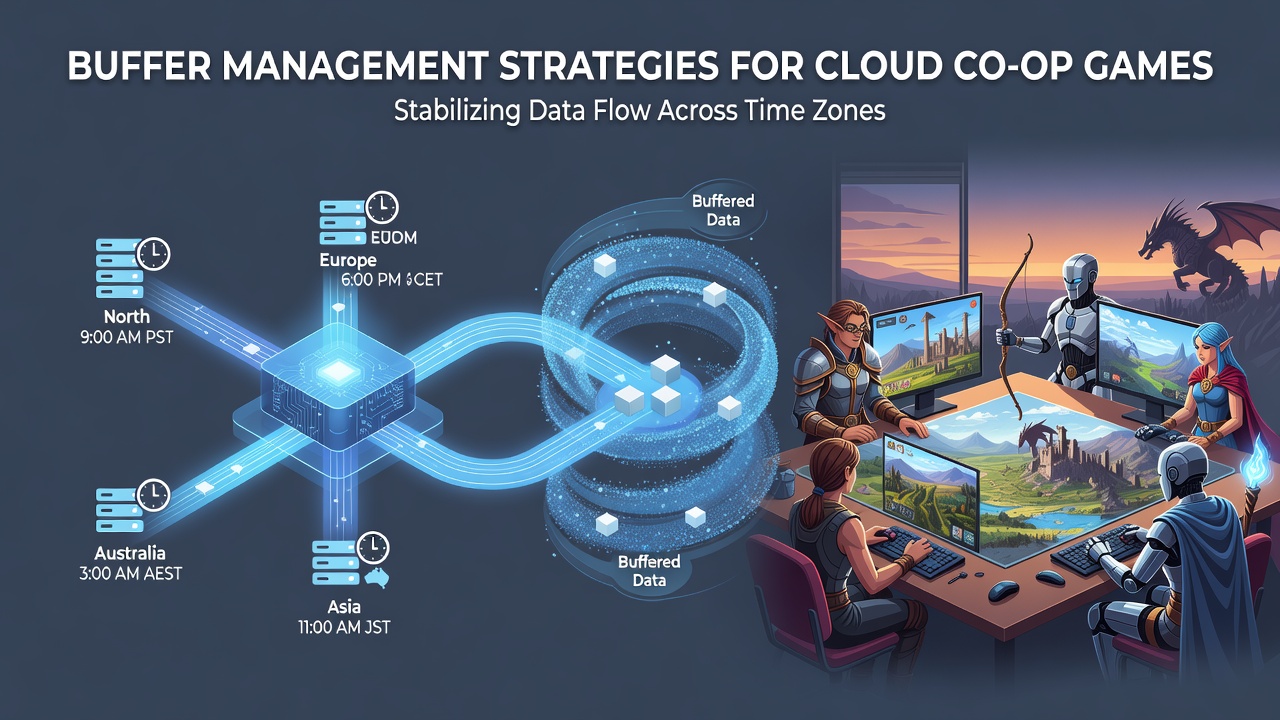
Exploring Buffer Management Strategies That Stabilize Data Flow in Cloud-Hosted Cooperative Adventure Games Across Multiple Time Zones
Buffer management strategies play a central role in maintaining steady data transmission for cloud-hosted cooperative adventure games that connect players across continents and time zones, and these approaches address latency variations that arise when servers handle synchronized player actions from regions operating on different clocks. Developers implement techniques that adjust buffer sizes dynamically based on network conditions, which helps prevent packet loss during peak synchronization events like group raids or shared exploration sequences.
Core Principles of Buffer Management in Distributed Gaming Environments
Systems rely on jitter buffers that collect incoming data packets before playback, and this collection process smooths out irregularities caused by varying transmission delays between time zones where one region experiences daytime traffic spikes while another faces nighttime maintenance windows. Adaptive algorithms monitor round-trip times and resize buffers accordingly, which maintains consistent frame delivery rates even as player counts fluctuate across global instances.
Research from the National Research Council Canada indicates that circular buffer implementations reduce memory overhead by reusing allocated space in real time, and such designs prove effective for adventure games requiring frequent state updates between cooperative teams separated by oceans. Engineers combine these buffers with predictive prefetching that anticipates player movements based on historical patterns, allowing servers to preload assets before actual requests arrive.
Challenges Posed by Multi-Time Zone Synchronization
Cooperative adventure titles must reconcile data flows where European players log in during evening hours while Asian counterparts join during morning sessions, creating overlapping demands that strain standard queuing methods. Time zone differences amplify issues like clock skew between data centers, and buffer strategies counter this through timestamp normalization that aligns events regardless of local server times.

One documented case involved a development team that integrated delay-based buffering after observing desyncs during cross-continental events, and their approach used statistical models to predict congestion windows rather than relying on fixed sizes. Data centers in October 2026 began rolling out enhanced versions of these models that incorporate machine learning to refine predictions from live traffic across distributed nodes.
Implementation Techniques and Performance Data
Teams deploy hybrid buffer systems that blend fixed and variable allocation, and this combination allows games to handle sudden influxes from players in distant zones without dropping critical action packets. According to a study published by the Commonwealth Scientific and Industrial Research Organisation in Australia, such hybrids lowered average latency variance by measurable margins in simulated global environments, with particular gains during synchronized boss encounters.
Active monitoring tools track buffer occupancy levels continuously, and alerts trigger adjustments when thresholds indicate impending overflow from mismatched time zone activity peaks. These tools integrate with edge nodes that process regional data locally before forwarding to central clouds, which shortens the effective distance data travels and eases pressure on primary buffers.
Case Examples from Industry Deployments
Developers at several studios have applied queue management protocols that prioritize cooperative action packets over less time-sensitive updates, and this prioritization keeps group interactions responsive even when one time zone contributes higher volumes of background traffic. Observers note that games using these protocols sustain higher player retention during multi-zone events because interruptions from data stalls decrease noticeably.
Further refinements include feedback loops where client devices report buffer status back to servers, enabling proactive scaling that prevents underflow in slower connections spanning multiple zones. Such loops operate in conjunction with compression schemes that shrink packet sizes without sacrificing essential game state information.
Conclusion
Buffer management continues to evolve as cloud infrastructure expands to support cooperative adventure games that span global time zones, and the strategies outlined here demonstrate how targeted adjustments stabilize data flow through adaptive sizing, predictive elements, and regional processing. Ongoing deployments in October 2026 reflect refinements drawn from operational data, which help maintain synchronization across diverse player bases. These methods provide the technical foundation for reliable experiences in distributed environments where timing differences would otherwise disrupt cooperative play.